Whisper API Alternative: When to Move from a Self-Hosted Model to a Transcription API
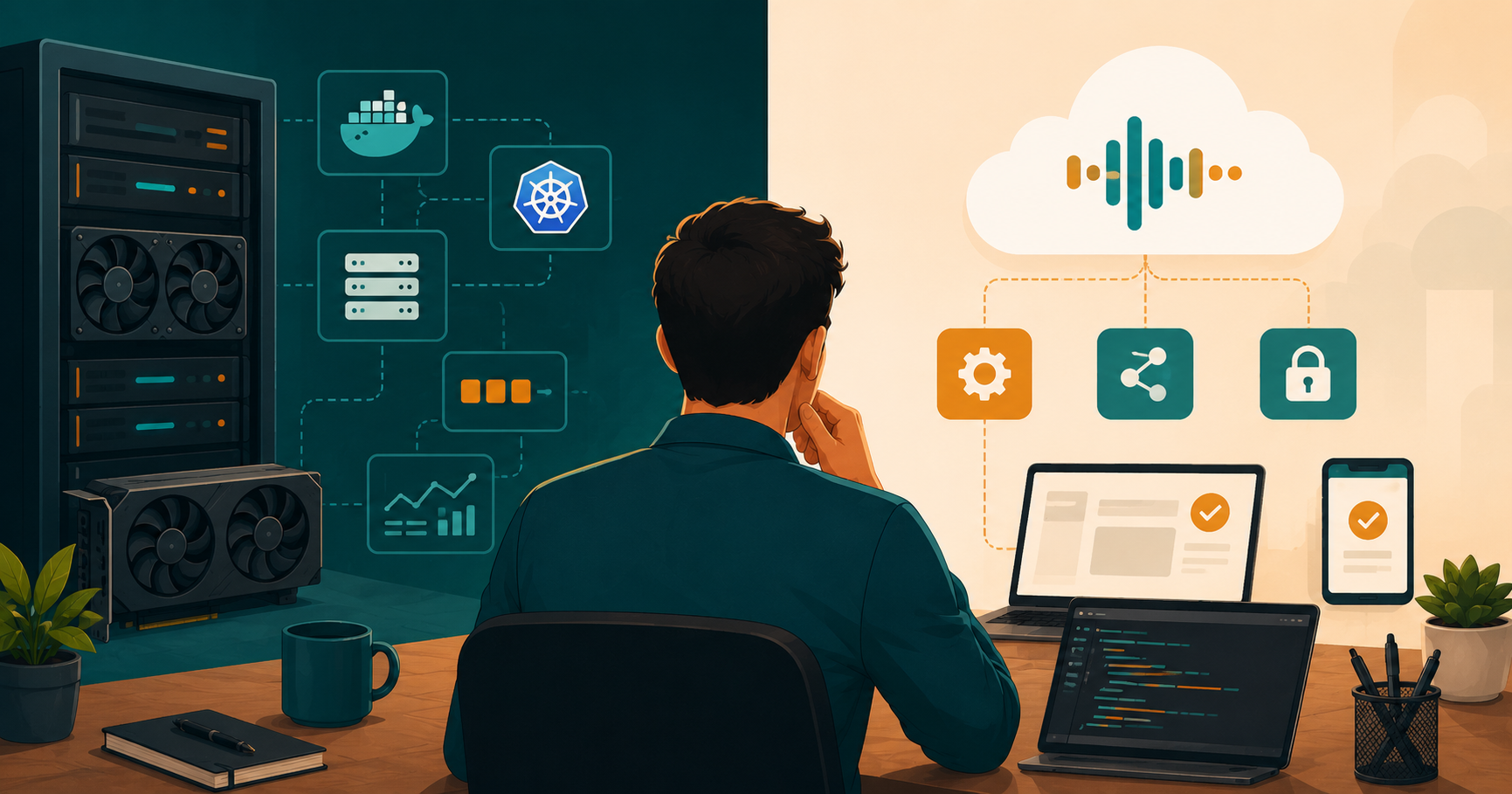
Whisper API Alternative: When to Move from a Self-Hosted Model to a Transcription API
Whisper is a good model. That is usually the first thing worth saying, because many articles on this topic open by positioning their product against OpenAI as if Whisper were a poor choice. It is not. Many teams adopted it for solid reasons, and they were right to do so.
The real question is not "is Whisper good?" but "does running it in production match what your team actually wants to manage?"
This article offers an honest framework: when to keep Whisper self-hosted, when to switch to a hosted API, and how to compare options objectively.
Why So Many Teams Start with Whisper
An Open, Accurate Model with No Usage Costs
Whisper was released by OpenAI under the MIT licence in 2022. It is accurate across a wide range of languages, including French with regional variations. It installs locally in a few lines of Python, requires no API key, and generates no per-use cost once a GPU is available.
For a prototype, a proof of concept, or batch processing on existing infrastructure, it is hard to beat. The community around Whisper is active: optimised forks (Faster-Whisper, WhisperX), ready-made integrations, deployment guides for Docker and Kubernetes. The starting point is solid.
When Self-Hosting Is Still the Right Call
Certain situations clearly justify keeping Whisper in-house.
Sensitive data that cannot leave the company's infrastructure (medical records, legal recordings, content under NDA) is the most obvious case. No cloud API is suitable when the constraint is that nothing leaves the perimeter.
In these situations, a third path exists between self-hosting Whisper and a hosted API: packaged on-premise transcription solutions from specialist providers. Companies like Vocapia offer transcription engines deployable directly on your own infrastructure, with API-grade quality and professional support, without audio ever leaving your network. This is worth considering seriously for organisations operating under strict data localisation requirements.
If your team already has MLOps expertise and you are processing a stable enough volume to amortise a dedicated GPU instance, self-hosting remains economically competitive. The same applies if you need to fine-tune the model on a very specific domain vocabulary: hosted APIs generally do not support that level of customisation.
The Real Cost of Whisper in Production
The initial deployment cost is low. The cost of keeping it running in production is a different story.
GPU Infrastructure and Scaling
Whisper requires a GPU for acceptable processing performance. An A10G or T4 instance on AWS or GCP costs between €0.50 and €1 per hour depending on configuration. If the instance runs continuously to handle peak loads, the GPU is often idle for a significant portion of the time. If you shut it down between jobs, cold start times add latency.
Auto-scaling is complex to implement properly: you need to anticipate traffic spikes, prevent queues from building up, and manage the cost of orchestration (Kubernetes, ECS, or equivalent).
Splitting Long Files and Queue Management
Whisper has a context window of roughly 30 minutes. Beyond that, you need to split the audio file, process each segment separately, then reassemble the transcriptions while managing overlaps to avoid words being cut mid-utterance.
This splitting logic is non-trivial. Queue management (Redis + Celery, RabbitMQ, or a custom solution) adds another layer to maintain and monitor.
Real-Time Streaming: A Project in Its Own Right
The base Whisper model is batch-oriented: it processes a complete file and returns a result. Real-time transcription requires a different approach: Whisper Streaming or solutions like whisper.cpp with reduced latency. This is a separate implementation, with its own challenges around audio chunk splitting, handling incomplete sentence endings, and progressively correcting results.
Combining batch and streaming in the same infrastructure doubles the surface area of code to maintain.
Maintenance, Error Recovery and No SLA
When Whisper fails on a particular file (unexpected audio format, long silence, corrupted recording), error recovery must be handled manually. There is no guaranteed SLA, no support team, no automatic alerting. The burden of monitoring and observability falls entirely on your team.
Model updates (moving to a more accurate version) require redeployment, regression testing, and sometimes migration of existing results.
When a Hosted Transcription API Becomes the Right Choice
Variable Volume and Unpredictable Load Spikes
If your transcription usage is irregular, a usage-based hosted API eliminates the idle GPU problem. You pay exactly what you consume. Load spikes are absorbed by the provider's infrastructure.
This is particularly relevant for consumer-facing applications where volume depends on user behaviour, for event-triggered processing (end of meeting, file upload), or for projects in a growth phase where load is not yet predictable.
Need for Real-Time Transcription
If your use case requires transcription while a conversation is in progress (customer support, live captioning, voice assistant, meeting notes), some hosted APIs expose a native WebSocket endpoint. You do not have to build the streaming logic yourself.
This is often the deciding factor: real-time transcription self-hosted represents several weeks of engineering work for a fragile result. An API with native WebSocket reduces that to a few hours of integration.
Compliance and Data Residency Requirements
GDPR imposes obligations on where personal data is processed. If your recordings contain voices of European citizens, certain legal or contractual contexts require processing to remain in Europe. Major US APIs (AWS Transcribe, Google Speech-to-Text, AssemblyAI) process data on US servers by default.
European providers, or those explicitly offering EU hosting, address this constraint. Check the availability of a DPA (Data Processing Agreement) before making any commitment.
Small Teams That Want to Focus on Their Product
Every hour spent maintaining transcription infrastructure is an hour not invested in the product. For a team of 3 to 10 people, the question is not purely technical: it is a matter of priorities.
Integrating an API takes a few hours. Maintaining a Whisper pipeline in production can occupy a significant fraction of one engineer's time. This ratio looks very different depending on team size and priorities.
How to Compare Transcription APIs Objectively
Accuracy and Language Coverage
Generic benchmarks (WER on LibriSpeech, CommonVoice) are useful reference points but do not always reflect performance on your real content. A customer meeting recording with background noise, domain-specific proper nouns, and regional accents behaves very differently from a clean academic corpus.
Test candidates on your own representative files before committing. Pay particular attention to accuracy on spoken language, numbers, proper nouns, and acronyms.
Latency and Streaming Mode
Distinguish two metrics: total processing time (for a complete file) and time-to-first-word latency (for streaming). These two figures are very different and correspond to different use cases.
Ask whether the API offers a native WebSocket or SSE mode for real-time, or whether streaming is an abstraction built on top of a batch model.
Pricing Model: Per Minute of Audio vs. Per Actual Speech Second
A 60-minute podcast often contains 5 to 10 minutes of music, jingles, and silences. With per-minute-of-audio pricing, you pay for those non-speech segments. With pricing based on actual speech time (as YobiYoba does), only the seconds where someone is actually speaking are counted.
At meaningful volume, the difference can exceed 15 to 20% of total cost. Run the calculation on your typical files before comparing listed prices.
Hosting, Compliance and Data Localisation
Check concretely: where are audio files sent? On which cloud region? Is data retained after processing? For how long? Does the provider offer a DPA? Can they commit contractually to not using your data for model training?
These questions are not limited to highly sensitive use cases. Many B2B customers raise them before approving any integration.
Documentation Quality and Code Examples
A good API with poor documentation is a bad API for integration. Assess the time required to go from "I sign up" to "I have my first transcript". Look for examples in curl, JavaScript and PHP (or the languages you use). Check whether error codes are documented with recommended actions.
Practical Example: Integrating Transcription in an Afternoon
A REST Call for a File
The endpoint is https://member.yobiyoba.com:8095/api. The recommended method for any type of audio is xs_trans. The language code for English is eng.
PUT request with parameters in the URL:
curl -ksS \
  -H "api-key: $YOBIYOBA_API_KEY" \
  "https://member.yobiyoba.com:8095/api?method=xs_trans&model=eng&audiofile=interview.wav" \
  -T interview.wav \
  > interview.xml
Or POST with a multipart form:
curl -ksS \
  -H "api-key: $YOBIYOBA_API_KEY" \
  https://member.yobiyoba.com:8095/api \
  -F method=xs_trans \
  -F model=eng \
  -F audiofile=@interview.wav \
  > interview.xml
The response is an XML document structured by speaker and segment, with timestamps and a confidence score per word:
<?xml version="1.0" encoding="UTF-8"?>
<AudioDoc name="interview.wav" path="interview.wav">
  <ChannelList>
    <Channel num="1" sigdur="60.00" spdur="49.83" nw="151" tconf="0.93"/>
  </ChannelList>
  <SpeakerList>
    <Speaker ch="1" dur="20.73" gender="1" spkid="MS1" lang="fre" lconf="0.99" nw="60" tconf="0.96"/>
    <Speaker ch="1" dur="12.08" gender="2" spkid="FS1" lang="fre" lconf="0.99" nw="45" tconf="0.95"/>
  </SpeakerList>
  <SegmentList>
    <SpeechSegment ch="1" sconf="1.00" stime="1.33" etime="8.84" spkid="MS1" lang="fre" lconf="0.99">
      <Word stime="1.48" dur="0.34" conf="0.978"> Good</Word>
      <Word stime="1.82" dur="0.35" conf="0.989"> morning</Word>
      <Word stime="2.19" dur="0.10" conf="0.995"> I</Word>
      <Word stime="2.33" dur="0.53" conf="0.970"> wanted</Word>
    </SpeechSegment>
    <SpeechSegment ch="1" sconf="1.00" stime="9.54" etime="11.90" spkid="FS1" lang="fre" lconf="0.99">
      <Word stime="9.60" dur="0.13" conf="0.996"> Exactly</Word>
      <Word stime="9.79" dur="0.23" conf="0.987"> that's</Word>
      <Word stime="10.04" dur="0.10" conf="0.989"> right</Word>
    </SpeechSegment>
  </SegmentList>
</AudioDoc>
Each <Word> carries stime (start time), dur (duration) and conf (confidence score between 0 and 1). The <Channel> exposes sigdur (total signal duration) and spdur (actual speech time, which is the billing basis). Note: even on errors, the server may return HTTP 200 with an <Error> tag in the XML body. Always check for its presence after each call.
In JavaScript (Node.js):
import { createReadStream } from 'fs';
import FormData from 'form-data';
import fetch from 'node-fetch';
import { XMLParser } from 'fast-xml-parser';

const audiofile = 'interview.wav';
const form = new FormData();
form.append('method', 'xs_trans');
form.append('model', 'eng');
form.append('audiofile', createReadStream(audiofile), { filename: audiofile });

const response = await fetch('https://member.yobiyoba.com:8095/api', {
  method: 'POST',
  headers: {
    'api-key': process.env.YOBIYOBA_API_KEY,
    ...form.getHeaders()
  },
  body: form
});

const xmlText = await response.text();
const parser  = new XMLParser({ ignoreAttributes: false, attributeNamePrefix: '@_' });
const doc     = parser.parse(xmlText);

// Check for API errors (HTTP 200 but <Error> tag is possible)
if (doc.Error) throw new Error(`YobiYoba error: ${doc.Error}`);

// Normalise to array (one segment or several)
const raw      = doc.AudioDoc.SegmentList.SpeechSegment;
const segments = Array.isArray(raw) ? raw : [raw];

const transcript = segments.flatMap(seg => {
  const words = Array.isArray(seg.Word) ? seg.Word : [seg.Word];
  return words.map(w => (typeof w === 'object' ? w['#text'] : String(w)));
}).join('');

console.log(transcript.trim());
In PHP:
<?php
$audiofile = 'interview.wav';
$lang      = 'eng';
$server    = 'member.yobiyoba.com';
$apiKey    = getenv('YOBIYOBA_API_KEY');

$ch = curl_init();
curl_setopt($ch, CURLOPT_HTTPHEADER,    ["api-key: {$apiKey}"]);
curl_setopt($ch, CURLOPT_SSL_VERIFYPEER, 0);
curl_setopt($ch, CURLOPT_URL,           "https://{$server}:8095/api?method=xs_trans&model={$lang}&audiofile={$audiofile}");
curl_setopt($ch, CURLOPT_PUT,           1);
curl_setopt($ch, CURLOPT_INFILE,        fopen($audiofile, 'rb'));
curl_setopt($ch, CURLOPT_RETURNTRANSFER, 1);

$xmlString = curl_exec($ch);

if (curl_error($ch)) {
    echo 'Curl error: ' . curl_error($ch);
} else {
    $xml = simplexml_load_string($xmlString);
    // Check for API errors
    if (isset($xml->Error)) {
        echo 'API error: ' . (string) $xml->Error;
    } else {
        $transcript = '';
        foreach ($xml->SegmentList->SpeechSegment as $segment) {
            foreach ($segment->Word as $word) {
                $transcript .= (string) $word;
            }
        }
        echo trim($transcript);
    }
}
curl_close($ch);
Streaming and Real-Time Transcription
YobiYoba also offers a streaming mode and a real-time mode, documented separately. These use a different endpoint and protocol from the file mode described here. See the streaming and real-time documentation for integration details.
In Practice: Keep Whisper, or Delegate?
There is no universal answer. A few criteria to help decide.
Keep Whisper self-hosted if:
- You have in-house MLOps expertise and a stable volume that amortises the GPU cost
- You need fine-tuning on very domain-specific vocabulary
- You are processing high enough volumes that fixed cost is lower than the variable cost of an API
Consider a packaged on-premise solution (e.g. Vocapia) if:
- Data absolutely cannot leave your infrastructure
- You need API-grade quality without the MLOps overhead
- You operate in a regulated sector (healthcare, defence, legal, finance)
Switch to a hosted API if:
- Your volume is variable or growing and you do not want to pay for an idle GPU
- You need real-time transcription without dedicating several weeks to the engineering
- You have GDPR or contractual requirements for EU-hosted processing
- Your team is small and prefers to invest its time in the product rather than infrastructure
In both cases: test on your own files before committing. Generic benchmarks do not measure what matters for your specific context.